DETAILS & CATALOGUING
To Ngoc Van
1906-1954
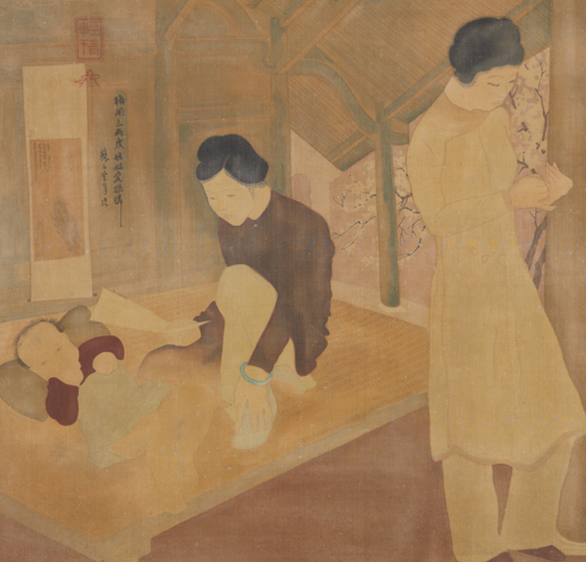
LÁ THU (THE LETTER)
Signed, inscribed and stamped with the seal of the artist
Ink and gouache on silk
69 by 69 cm; 27 1/4 by 27 1/4 in.
READ CONDITION REPORT
SALEROOM NOTICE
PROVENANCE
Private Collection, Singapore
EXHIBITED
Paris, Grand Palais, Salon de 1932 Societe des Artistes Français (Society of French Artists), Honorary Mention
LITERATURE
Ha Thuc Can, Dao Hung, 100 years of Contemporary Paintings from Vietnam, Dong Son Editions, Singapore, 1994/1995, p. 8
Các Họa Si Trư ỡng Cao, đắng mỹ thuật đông dương, Les Peintres De L 'Ecole Superieure Des Beuax-Arts De L 'lndochine, Painters of the Fine Arts College of Indochina, Fine Arts House, Hanoi, 1993, p.11
CATALOGUE NOTE
An exquisite treasure from the zenith of modern Vietnamese art, Lá Thu (The Letter) by To Ngoc Van is an outstanding masterpiece that puts the maestro’s visual acuity on full display. The traditional Vietnamese interior and its beatific women are a captivating amalgamation of Eastern aesthetics and a sensitivity towards Western realism. It is the work’s refreshing ingenuity that stood out amongst Ngoc Van’s French and Vietnamese contemporaries, launching Lá Thu to international heights and later awarded with an honorable mention from the prestigious Salon de 1932 Societe des Artistes Français (Society of French Artists) exhibition held at the Grand Palais, in Paris. In Lá Thu, To envisages an intimate scene of a Vietnamese domestic household, presenting a charming vision of a baby being read to by two surrounding women. Situated in the romantic shade of Vietnamese architecture, the Eastern setting pays homage to To’s roots. A hallmark of To Ngoc Van’s innovative mind, the work is a powerful combination of the artist’s effortless proficiency and flourishing imagination.
The beginnings of To Ngoc Van’s celebrated career started with his matriculation at the esteemed Ecole des Beaux-Arts de L’Indochine (Indochina College of Fine Arts). The French colonial school exposed the fledgling painter to European grand-master traditions, the Western teachings leaving an indelible influence across his oeuvre. Lá Thu is a rare production from To’s oeuvre, retaining a classical European integrity found only in his earlier works. Graduating in 1931, To was part of the first generation of modern Vietnamese artists, propelling a style underpinned by a consciousness of Western realism yet rooted in quintessential Vietnamese character. Lá Thu is thus a culmination of the artist’s diverse training, depicting a poetic vignette of Vietnamese domestic life with Western notions of perspective and viewership. Against the smooth sheen of silk, the painting has a translucent, diaphanous finish that impresses the work with a delicate elegance.
One of Lá Thu’s most salient features is its arrestingly unique composition. Across his vast opus, To’s paintings are marked by an unconventional asymmetry that attests to the artist’s mutable flair and striking individuality. The seemingly minimalist surface of Lá Thu is composed in a discordant series of asymmetrical visual planes, contriving an intricate complexity of layers that immediately engage the eye. To Ngoc Van foregrounds the yellow-green interior with a saturated coat of red flooring, the juxtaposed tonalities producing a bold, gripping color block composition. Positioned at the periphery, a woman is garbed in a pearlescent áo dài, her lean body encompassing the extensive length of the house’s column. To astutely places her at the cardinal point of the work, creatively demarcating an invisible boundary between the interior and exterior setting. In the far distance, a cherry blossom tree is in full bloom, the spray of white flowers encroaching upon the private home. A symbol of the arrival of spring, the blooming tree is in fortuitously timed with the baby’s birth, its loaded meaning emblematic of Lá Thu’s multi-faceted nature.
The artist further plays with modern ideas of the gaze by featuring an artwork within the present composition. Hanging on the far right is an immaculately rendered scroll painting, accompanied by a short inscription written exclusively in calligraphy. The traditional format is thus introduced within To’s reinterpretation of artistic creation, the three figures becoming both viewers and subjects of viewership. The characters are etched directly above the titular letter, bringing its contents into materiality. Posited at a time of rebirth, the woman reads a letter that is perhaps from a loved one from afar, celebrating the child’s arrival into the family. Through the sheer inventiveness of composition alone, To conjures a scenario that captures the interplays between family members in a traditional Vietnamese household.
In Lá Thu, To incorporates his ubiquitous motif of fuller, voluminous figures engaged in their natural milieu.[1] Adorned in the dignified Vietnamese attire of áo dài, the women are a resplendent picture of sophistication and grace. Kneeling over the resting baby, the lady’s darkened brown dress billows outwards into a sheer wash, an effect that can only be achieved through the satin quality of Vietnamese silk. Even against the painting’s challenging surface, the colors are expertly administered and remain bound to their thin outlines, testifying to the maestro’s skillful familiarity with a varied array of mediums. A fastidious painter, To pays meticulous attention to the folds of their dress, instilling a realistic aura that recalled his Western education at the French school. A jade bracelet dangles from the woman’s wrist, the marbled green standing in vivid juxtaposition against the painting’s muted palette. In East Asia, jade was sought after for its good fortune and its protection against evil. The proximity of the jewelry’s presence to the baby thus spoke of the woman’s desires to guard the child’s innocence.
Across rapid modernization and an increasing exposure to Western traditions, To’s incorporation of Eastern iconography in his works testifies to the artist’s ardent loyalty for his Vietnamese roots. A rare, sentimental piece, Lá Thu is a nostalgic recollection of a child’s unadulterated innocence and a maternal desire to protect it.
[1] Ha Thuc Can., Dao Hung, 100 Years of Contemporary Painting from Vietnam, Dong Son Editions 1994, 6.
Modern & Contemporary Southeast Asian Art Aug 29, 2019
By Sotheby's
Vietnamese artists have been having a moment in the modern and contemporary art scene. In recent years, the Vietnamese fine art market has been enjoying more of the spotlight, paintings have commanded higher prices, and talented artists have emerged on the global stage in greater numbers.
...
To Ngoc Van (1906–1954)
067HK0917_BBJG3.jpg
TO NGOC VAN, THE LETTER, INK AND GOUACHE ON SILK, 69 BY 69 CM; 27 1/4 BY 27 1/4 IN. ESTIMATE: HK$800,000-1,500,000.
An exquisite treasure of modern Vietnamese art, La Thu (The Letter) by To Ngoc Van is a masterpiece that puts the maestro’s visual acuity on full display. To was part of the first generation of modern Vietnamese artists, propelling a style underpinned by a consciousness of European realism yet rooted in quintessential Vietnamese character. La Thu opens to an intimate domestic scene; a baby is surrounded by two women, one reading the titular letter from, perhaps, a loved one who is far away. In the distance, a cherry blossom tree is in full bloom, heralding the arrival of spring, fortuitously timed with the baby’s birth.
The painting is a rare work from To Ngoc Van’s oeuvre, retaining a classical European integrity found only in his earlier works. La Thu is thus a culmination of the artist’s diverse training, depicting a poetic vignette of Vietnamese domestic life from a Western perspective. One of La Thu’s most salient features is its arresting, unique composition. To’s paintings are typically distinguished by an unconventional asymmetry that attests to the artist’s flair and individuality. Across rapid modernization and an increasing exposure to Western traditions, To’s incorporation of Eastern iconography in his works testifies to the artist’s ardent loyalty for his Vietnamese roots. A rare, sentimental piece, La Thu is a nostalgic recollection of a child’s unadulterated innocence and a maternal desire to protect it.
 Tranh màu nước "Quán bên đường", 32x49,6cm,1951 của HS Tô Ngọc Vân.